Modern Solutions Across Business, Manufacturing, Health, and Environmental Innovation
Introduction
Innovation today rarely fits neatly into one industry. Business strategy, manufacturing efficiency, healthcare delivery, and environmental responsibility are increasingly interconnected. Decisions made in one area often ripple across others, affecting cost structures, risk exposure, customer expectations, and long-term sustainability.
What separates successful organizations from those struggling to adapt is not access to technology alone, but the ability to apply modern solutions intentionally. That means planning ahead, measuring accurately, managing risk proactively, and aligning innovation with real operational needs rather than trends.
This article explores how organizations across multiple sectors are adopting practical, forward-looking solutions. Each section focuses on actionable strategies that leaders can apply to improve resilience, efficiency, and performance in a rapidly evolving landscape.
Strengthen Long-Term Business Stability Through Proactive Financial Planning
Long-term stability is built long before a business owner or executive considers stepping away. Financial foresight helps organizations withstand market volatility, leadership transitions, and unexpected disruptions while preserving value for stakeholders.
Retirement planning is not just a personal consideration for owners and executives. It directly influences business strategy, capital allocation, and risk tolerance. When personal financial goals are unclear, business decisions often become reactive rather than strategic.
Succession planning complements this process by addressing leadership continuity. Without a clear transition strategy, organizations face uncertainty that can affect employees, customers, and valuation.
Key components of proactive financial planning include:
-
Clarifying long-term personal and organizational goals
-
Separating personal and business financial dependencies
-
Identifying future leadership requirements early
-
Structuring ownership transitions to minimize disruption
Organizations that integrate these considerations benefit from:
-
Stronger investor and lender confidence
-
Reduced operational risk during transitions
-
Improved strategic decision-making
-
Greater flexibility during periods of change
Proactive planning transforms uncertainty into preparedness, allowing businesses to grow with intention rather than urgency.
Build Service Models That Support Mobility and Flexible Lifestyles
Modern consumers increasingly value flexibility, mobility, and convenience. Businesses that serve mobile customers must adapt their service models accordingly, balancing responsiveness with operational efficiency.
An rv service operation highlights the complexity of supporting assets that move across locations, climates, and usage patterns. Success depends on anticipating needs rather than reacting to breakdowns.
Key challenges in mobile service delivery include:
-
Coordinating logistics across wide geographic areas
-
Managing inventory and parts availability
-
Scheduling technicians efficiently
-
Maintaining consistent service quality
Effective service models address these challenges by:
-
Using predictive maintenance insights
-
Standardizing service protocols
-
Training technicians for broad problem sets
-
Leveraging customer communication tools
Organizations that support mobility effectively build trust and loyalty, turning convenience into a competitive advantage rather than a cost burden.
Improve Market Reach With Data-Driven Promotion Strategies

Reaching the right audience today requires more than creative messaging. Data-driven promotion allows organizations to allocate resources efficiently while adapting quickly to performance insights.
Digital marketing has evolved from experimentation into a core operational function. When guided by data rather than intuition, it becomes a measurable growth driver rather than a discretionary expense.
Effective data-driven strategies focus on:
-
Audience segmentation based on behavior and intent
-
Channel performance analysis
-
Content optimization through testing
-
Conversion tracking across touchpoints
To maximize impact, organizations should:
-
Align campaigns with specific business objectives
-
Use analytics to guide budget allocation
-
Continuously refine messaging based on results
-
Measure success beyond clicks and impressions
When marketing decisions are grounded in evidence, organizations gain clarity on what works, what doesn’t, and where to invest next.
Prepare Organizations to Withstand Uncertainty Through Structured Risk Evaluation
Innovation introduces opportunity, but it also introduces risk. Organizations that fail to evaluate risk systematically often encounter avoidable setbacks that slow progress or erode trust.
Risk assessment services provide structured frameworks for identifying vulnerabilities across operations, finances, compliance, and technology. These evaluations replace assumptions with evidence, enabling informed decisions.
Effective risk evaluation involves:
-
Identifying internal and external threats
-
Assessing likelihood and potential impact
-
Prioritizing mitigation strategies
-
Monitoring changes over time
Organizations that integrate risk evaluation into planning processes benefit from:
-
More resilient operations
-
Better investment prioritization
-
Reduced surprise disruptions
-
Stronger governance practices
Risk management is not about avoiding change. It is about pursuing innovation with awareness and preparation.
Enhance Production Accuracy and Oversight With Real-Time Visibility

Manufacturing environments demand precision, coordination, and accountability. Without clear visibility into operations, inefficiencies compound and quality suffers.
Production monitors provide real-time insight into workflows, output, and system status. When implemented thoughtfully, they support faster decision-making at every level of the organization.
Benefits of enhanced visibility include:
-
Faster identification of bottlenecks
-
Improved quality control
-
Reduced downtime
-
Better alignment between teams
To implement effective monitoring systems, organizations should:
-
Define what information is truly actionable
-
Avoid overwhelming operators with unnecessary data
-
Integrate displays with existing systems
-
Use insights to drive continuous improvement
Visibility transforms production from reactive troubleshooting to proactive optimization.
Optimize Industrial Systems by Focusing on Flow Control Efficiency
Industrial efficiency often hinges on components that receive little attention until they fail. Flow control elements play a critical role in system performance, energy use, and reliability.
Butterfly dampers are widely used in industrial systems to regulate airflow and fluid movement. Their performance affects everything from energy efficiency to equipment longevity.
Optimizing flow control involves:
-
Selecting components suited to operating conditions
-
Ensuring proper installation and calibration
-
Establishing regular inspection routines
-
Monitoring performance over time
Organizations that prioritize system-level efficiency benefit from:
-
Lower energy consumption
-
Reduced maintenance costs
-
Improved process stability
-
Longer equipment lifespan
Small improvements in system components often yield outsized operational gains.
Expand Custom Manufacturing Capabilities Without Sacrificing Consistency
Demand for customization continues to grow, even in traditionally standardized manufacturing environments. Customers increasingly expect products that reflect their specific needs, branding, or use cases, and they expect those products to arrive quickly and perform reliably. For manufacturers, this creates a tension between flexibility and control. Without a structured approach, customization can introduce inefficiencies, quality risks, and operational complexity that undermine profitability.
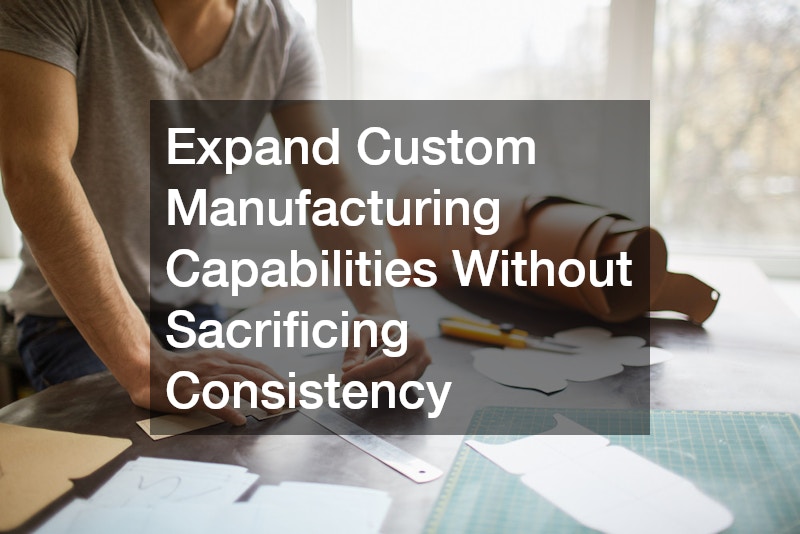
Embroidery supplies illustrate these challenges clearly. Differences in thread types, fabric blends, design density, color matching, and order volumes all introduce variability. If each custom order is treated as a one-off, production teams are forced to reinvent workflows repeatedly, increasing error rates and slowing output. Scaling customization successfully requires systems that absorb variability without sacrificing repeatability.
One of the most effective strategies is identifying where standardization can exist beneath the surface of customization. While the final product may vary, many upstream inputs and processes do not need to. For example, limiting approved materials to a vetted list reduces quality issues while still allowing a wide range of end designs. Similarly, standardizing file formats, approval steps, and setup procedures minimizes confusion and rework.
Key operational strategies include:
-
Creating clear design guidelines that customers must follow to ensure compatibility with production capabilities
-
Grouping similar custom orders into production batches to reduce setup time
-
Using templates or preconfigured options to streamline decision-making
-
Investing in documentation that captures best practices and lessons learned
Inventory planning plays an especially important role in customized environments. Carrying excessive stock of low-use materials ties up capital, while insufficient inventory creates delays and customer dissatisfaction. Data-driven forecasting, combined with supplier partnerships that support shorter lead times, helps strike the right balance. Modular inventory strategies—where base components are stocked and customized late in the process—can further reduce risk.
Quality control must also evolve alongside customization. Inspection criteria should be clearly defined for both standard and variable elements, and teams should be trained to identify defects that are specific to custom work, such as alignment issues or inconsistencies introduced during changeovers. Feedback loops between quality teams, operators, and designers help prevent recurring issues.
Organizations that approach customization strategically benefit in several ways:
-
Faster turnaround times due to reduced friction in workflows
-
Consistent product quality across a wide range of variations
-
Lower material waste and fewer rejected orders
-
Greater confidence when accepting complex or high-volume custom projects
Ultimately, customization becomes a competitive advantage when it is treated as a system to be engineered, not an exception to be managed. Disciplined processes allow manufacturers to say “yes” to more customer requests without compromising operational stability.
Support Health and Wellness Through Technological and Service Innovation
Healthcare innovation increasingly centers on experience as well as outcomes. Patients are more informed, more selective, and more sensitive to how care is delivered. Beyond clinical results, they evaluate convenience, communication, comfort, and trust. Providers who align technology with service design are better positioned to meet these expectations.
Cosmetic dentistry exemplifies this shift. Once focused primarily on aesthetics, the field now integrates advanced diagnostics, digital planning, and minimally invasive techniques that improve both results and patient experience. Technology has expanded what is possible, but its true value emerges only when paired with thoughtful workflows and human-centered care.
Modern practices are investing in tools that enhance precision and predictability. Digital imaging, 3D modeling, and computer-assisted design allow practitioners to plan treatments more accurately and communicate expected outcomes clearly. This transparency builds confidence and reduces anxiety, particularly for patients undergoing elective procedures.
However, technology alone does not create a positive experience. Operational efficiency plays a major role in how patients perceive care. Long wait times, unclear billing, or inconsistent communication can overshadow even the best clinical work. Streamlined scheduling systems, clear intake processes, and proactive follow-up all contribute to smoother patient journeys.
Effective practices focus on several interconnected areas:
-
Integrating diagnostic and treatment technologies that support consistency and safety
-
Designing workflows that minimize idle time and unnecessary handoffs
-
Using visual aids and plain language to explain procedures and options
-
Training staff to recognize and respond to patient concerns empathetically
Staff training deserves particular attention. As technology evolves, team members must be comfortable not only using new tools but also explaining them. When front-desk staff, assistants, and clinicians present a unified message, patients feel supported rather than overwhelmed. Ongoing education ensures that service quality keeps pace with technical capability.
The business impact of this approach is significant. Practices that deliver a strong experience see higher acceptance rates for treatment plans, more referrals, and stronger long-term relationships. Patients who feel informed and respected are more likely to return and to advocate for the practice.
Innovation in healthcare is most effective when it enhances trust. By aligning technology, workflows, and communication, providers create environments where patients feel confident in both the care they receive and the professionals delivering it.
Address Environmental Challenges With Science-Driven Solutions
Environmental responsibility has moved from aspiration to expectation. Regulators, customers, and communities increasingly scrutinize how organizations manage resources and mitigate environmental impact. Addressing complex challenges requires more than surface-level initiatives; it demands evidence-based strategies grounded in science and long-term thinking.
Microplastics have emerged as a particularly pressing concern due to their durability, small size, and widespread distribution across ecosystems. These particles originate from product degradation, manufacturing processes, and waste streams, making them difficult to trace and control. Their potential effects on human health and the environment have elevated them from a niche issue to a mainstream priority.
Organizations cannot solve this challenge alone, but they can play a meaningful role. The first step is understanding where environmental impact occurs within their operations. Mapping material flows, identifying sources of waste, and evaluating lifecycle impacts provide a foundation for informed decision-making. Without this visibility, improvement efforts risk being symbolic rather than effective.
Practical steps organizations can take include:
-
Reviewing raw material choices and prioritizing alternatives with lower environmental persistence
-
Improving filtration and capture systems within manufacturing and processing environments
-
Collaborating with suppliers to reduce packaging and improve recyclability
-
Supporting internal or external research that advances detection and mitigation techniques
Preparing for regulatory change is another critical consideration. As scientific understanding evolves, standards and reporting requirements are likely to follow. Organizations that proactively adapt are better positioned to manage compliance costs and avoid disruption. Building flexibility into processes and staying informed about emerging research helps reduce uncertainty.
Environmental initiatives also intersect with reputation and resilience. Customers and partners increasingly favor organizations that demonstrate credible environmental stewardship. Transparency about challenges and progress builds trust, particularly when actions are supported by data rather than marketing claims.
Most importantly, environmental responsibility should be integrated into core strategy rather than treated as a separate effort. When sustainability considerations inform design, sourcing, and operations, organizations are better equipped to navigate future risks. Addressing environmental challenges through science-driven solutions strengthens long-term viability while contributing to broader societal goals.
Conclusion
Modern solutions across business, manufacturing, health, and environmental innovation share common principles: intentional planning, accurate measurement, risk awareness, and alignment with long-term goals. Organizations that succeed are those that integrate these principles into daily decision-making rather than treating innovation as a one-time project.
By applying practical strategies thoughtfully, leaders can navigate complexity with confidence, build resilient systems, and create value that endures in an ever-changing world.